Introduction
Eggs are one of the most versatile ingredients in cooking and baking. They create structure in a fluffy angel food cake, add richness to custards, and bind together everything from cookies to meatballs. But there are times when we need to replace eggs – whether due to a nationwide egg shortage or personal needs like vegan diets, allergies, or health concerns. Having reliable egg substitutes on hand can save the day when you’re out of eggs or cooking for someone who can’t eat them.
In this guide, we’ll explore both homemade and commercial egg substitutes for a variety of kitchen applications. Consider this your go-to resource for understanding how eggs function in recipes and how to mimic those functions with other ingredients. The tone here is warm and encouraging (think Martha Stewart inviting you into her kitchen), but also authoritative and well-researched. By the end, you’ll know exactly what to use when you need to replace an egg in anything from a delicate soufflé to a batch of muffins. Let’s crack the code on egg substitutes!
Why Eggs Are Important in Cooking
Before choosing a substitute, it helps to understand what eggs do in a recipe. Eggs are truly multifunctional: they can bind ingredients, leaven batters, add moisture and fat, emulsify sauces, and give structure to foods. Here’s a closer look at these core functions of eggs in cooking:
- Binding: Eggs act as the glue that holds ingredients together. The proteins in eggs coagulate (solidify) when heated, binding and giving strength to mixtures. For example, in cookies and meatballs, eggs keep the mixture from crumbling apart (What Is the Role of Eggs in Baking?). Think of egg as the binder that helps a meatball hold its shape or a cookie dough stay together during baking.
- Leavening: Eggs help leaven (rise) baked goods by trapping air. Beaten eggs, especially egg whites, create tiny air bubbles that expand in the oven’s heat, lifting the batter. This is crucial for cakes, soufflés, meringues, and pancakes. In an angel food cake or soufflé, whipped egg whites incorporate air and make the structure light and airy (Happy Egg • What Eggs Actually Do in Baking) . Whole eggs can also contribute to rise via steam – eggs contain water, and as that water heats, it turns to steam and puffs up pastries like cream puffs.
- Moisture & Fat: Eggs are high in water content (about 75% water) and also contain fats (in the yolk). This means they add moisture and richness to recipes. The water in eggs keeps baked goods moist and tender (The Science of Baking), while the fat in egg yolks creates a velvety texture and enhances flavor (Happy Egg • What Eggs Actually Do in Baking). In a muffin or cake, eggs contribute to a softer, moist crumb. The yolk’s fat also shortens gluten strands for a more tender bite (Tenderization/Texture – American Egg Board). More egg yolks often mean a richer, more tender dessert.
- Emulsification: Egg yolks contain natural emulsifiers like lecithin. An emulsifier helps blend ingredients that normally don’t mix, like oil and water, into a stable mixture. This is why egg yolk is the key to making mayonnaise and hollandaise – it keeps the oil and lemon juice or vinegar from separating. In baking, eggs help create smooth batters by emulsifying fats and liquids). The result is a uniform texture. For example, adding an egg to cake batter helps evenly distribute the butter or oil throughout the mix preventing it from separating and giving the cake a consistent crumb.
- Structure: When heated, eggs provide structure and firmness to foods by coagulation of proteins. In custards and quiches, eggs firm up the filling so it sets into a sliceable dish. In baked goods, eggs solidify to help the item hold its shape – think of how a pancake or crepe firms up once the egg in it cooks. Egg proteins create a network that supports the rise and shape of cakes as well. In airy dishes like meringues and pavlovas, eggs (especially whipped whites) not only leaven but also dry out and set in the oven to form a crisp structure that holds its shape. Without eggs, many of these foods would collapse or remain too wet.
In short, eggs are a cook’s multi-tool, contributing binding, lift, moisture, richness, emulsifying power, and structure. Knowing this, we can be strategic about replacing them. Different substitutes replicate different egg functions. Let’s explore the best options, starting with homemade substitutes you can whip up from common ingredients.
The Best Homemade Egg Substitutes (For Various Uses)
When you’re egg-free by necessity or choice, your pantry likely holds a solution. These homemade egg substitutes use simple ingredients to mimic eggs in specific ways. Some excel as binders in baking, others add moisture or act as leaveners. Here are some of the top DIY egg replacers and how to use them:
Flaxseed “Egg” (Best for baking)
Ground flaxseed is a fantastic all-purpose egg replacer in baking. When mixed with water, ground flaxseed turns into a gel that acts very much like an egg in batters. It’s excellent for binding and adding a bit of moisture, though it won’t provide much leavening on its own. Use it in quick breads, muffins, cookies, brownies, pancakes, and even as a binder in things like veggie burgers.
How to make a flax egg: Combine 1 tablespoon of ground flaxseed meal with 3 tablespoons of water for each egg you need to replace). Stir and let the mixture sit for about 5 minutes (it will thicken and become gelatinous). This gooey mixture can then be added to your recipe in place of a beaten egg.
Why it works: Flaxseeds are high in soluble fiber which thickens in water and mimics the viscosity of egg whites. The flax gel helps bind ingredients together (similar to how egg protein would) and adds a bit of moisture. Flax “eggs” work especially well in denser baked goods that don’t rely on eggs for a lot of rising power. For example, in a batch of chocolate chip cookies or a banana bread, a flax egg will hold the batter together and contribute to a tender, chewy texture (DIY egg substitutes | PCC Community Markets)’
Tips: Flax has a mild nutty flavor that is usually not noticeable in most recipes (it tends to disappear into chocolate, spices, etc.). Golden flaxseed meal has a lighter color and flavor than brown flax, but either works. If a recipe calls for more than 2 eggs, flax might not be sufficient on its own to provide structure or lift. Also remember flaxseed won’t whip into a foam, so it can’t replace egg whites for meringue or souffle. Think of it as a binder and moisture enhancer. Many vegan bakers swear by flax eggs for cookies and muffins. In fact, ground flax is often used in commercial egg replacer products as one of the ingredients because of its reliable binding power.

Ground organic flaxseed with great nutty taste
3 gram of dietary fiber per serving; 98 Milligrams of Lignans per serving
Rich in Omega 3 (ALA) fatty acids
98 Milligrams of Lignans per serving
Contains one 24 oz pack of Spectrum Essentials Organic Ground Premium Flaxseed
Refrigerate after opening: To store, press air out of punch and seal tightly. Best if used within 3-4 months after opening and can be frozen to extend shelf life.
Chia Seed “Egg” (Great alternative to flax)
Chia seeds can be used in much the same way as flaxseeds to create a gel-like egg replacement. When mixed with water, chia seeds swell and form a thick gel. A chia “egg” is excellent for binding and moisture in recipes, and can be used interchangeably with flax eggs in most cases. If you’re out of flax or prefer chia, this is your go-to.
How to make a chia egg: Mix 1 tablespoon of chia seeds (whole or ground) with 3 tablespoons of water and let it sit about 5-10 minutes until it turns into a gel. The ratio is the same as for flax: 1:3 works well (How to Make a Chia Egg – Wholehearted Eats) (Best egg alternatives and substitutes amid rising prices, spread of bird flu – Good Morning America). You can grind the chia seeds first for a smoother gel, or use them whole – whole chia will result in a speckled appearance (little black or white dots) in your finished product, which is usually fine in darker baked goods. Ground chia might bind slightly better and more uniformly.
Uses: Chia “eggs” shine in baking – muffins, quick breads, pancakes, waffles, cookies, brownies. They add moisture and binding. For example, you can use a chia egg in a batch of blueberry muffins or oatmeal cookies with great results (just as you would a flax egg). Chia seeds have very little flavor, so they won’t interfere with the taste of your dish. They are also quite shelf-stable, making them handy to keep around (How to Make a Chia Egg – Wholehearted Eats).
Why it works: Chia seeds are rich in fiber and mucilage, which is a gel-forming soluble fiber. This mimics the viscosity of eggs and helps hold ingredients together (How to Make a Chia Egg – Wholehearted Eats). The gel provides some structure and prevents crumbling. However, like flax, chia won’t create lift – your recipe should have another leavening agent (baking soda/powder or yeast) if rise is needed (How to Make a Chia Egg – Wholehearted Eats). Chia eggs add no fluff, just binding and moisture.
Tip: If using ground chia, be aware it can go rancid over time – store it in the fridge or freezer. Also, allow the chia gel enough time to fully hydrate; a few extra minutes of soaking won’t hurt, and stirring once midway helps evenly gel the mixture (How to Make a Chia Egg – Wholehearted Eats) (How to Make a Chia Egg – Wholehearted Eats). Use chia eggs in recipes where eggs are not the central component but just a binder (for instance, pancakes, where baking powder provides the rise and chia just holds things together (How to Make a Chia Egg – Wholehearted Eats)). Avoid using chia or flax alone in very light, delicate cakes or recipes calling for many eggs – they just can’t trap air or firm up the way eggs do in those contexts.

Ground chia seeds, a nutritional powerhouse used by ancient Aztecs and Mayans
Good source of ala omega-3 essential fatty acid that helps support heart health
4 grams of dietary fiber per serving
Higher in antioxidant activity than blueberries
Neutral flavor means chia seeds can be easily blended into smoothies or your other favorite foods without affecting the taste
Applesauce (Best for moisture in cakes, muffins, brownies)
Unsweetened applesauce is a popular egg substitute for adding moisture. If a recipe uses eggs mostly for moisture content (and some binding), fruit purees like applesauce can step in. This is common in low-fat or vegan baking. Applesauce makes baked goods tender and moist, though it does not bind as strongly as an egg and provides zero leavening. It’s best used in combination with recipes that have other leaveners and in which a little extra density is acceptable.
How to use: Replace 1 egg with 1/4 cup of applesauce (about 4 tablespoons) (DIY egg substitutes | PCC Community Markets) (Best Egg Substitutes For Baking). This works best with unsweetened applesauce to avoid adding extra sugar. If you only have sweetened, you may need to reduce sugar in the recipe slightly. Simply stir the applesauce in as you would a beaten egg.
Best in: Cakes, quick breads, muffins, brownies, and bars – especially those that are meant to be moist and a bit dense. For example, applesauce is fantastic in a fudgy brownie or a spice cake. It keeps them soft and moist. It’s also used in some cookie recipes (particularly breakfast cookies or healthy cookies) for a soft, cake-like texture. Southern chefs note that applesauce is a “neutral” egg replacer, meaning it doesn’t impart a strong flavor (Best Egg Substitutes For Baking), so it’s versatile.
Pros: Adds a lot of moisture and some natural sweetness. It can make your baked goods lower in fat and cholesterol (great for lighter baking). Also, because applesauce is thick, it does provide some binding – the pectin in apples can help hold things together lightly.
Cons/caveats: Applesauce alone doesn’t help your dish rise. In fact, it can make the texture a bit heavier if you’re not careful. One pro tip is to add a little extra baking powder when using applesauce as an egg sub, to boost the leavening. For instance, if you replace an egg with 1/4 cup applesauce, you might add an extra 1/2 teaspoon of baking powder to ensure the baked good isn’t too dense (Best Egg Substitutes For Baking). Applesauce can also create a slightly rubbery texture if overused – many recipes advise not replacing more than 2 eggs with fruit puree in a given recipe (DIY egg substitutes | PCC Community Markets). If a recipe calls for 3 or 4 eggs, using applesauce for all might make it gummy, so it’s often combined with another substitute or used when only 1 egg is needed.
Flavor: Very neutral in most recipes. You won’t really taste apple, especially if the recipe has spices, chocolate, or strong flavors. If used in a very plain recipe, there might be a hint of fruitiness, but generally it’s subtle (unlike banana, which has a stronger flavor).

100% USA Apples
Contains No Allergens or Artifical Ingredients
No Sugar Added
50% DV Vitamin C
Free From Added Sugar
Mashed Banana (Adds sweetness and moisture; best for dense baked goods)
A ripe banana can act as a binder and moisture enhancer in baking. Mashed banana is similar to applesauce in that it adds moisture and some binding, but banana has more starch and fiber which can help bind a bit better. It will, however, lend its distinct flavor to the recipe. Use banana as an egg replacer when a hint of banana flavor would be welcome, or at least not overpowering.
How to use: About 1/4 cup of mashed ripe banana (roughly half a large banana) equals one egg (DIY egg substitutes | PCC Community Markets). Mash it very well so there are no lumps (or use a blender for an ultra-smooth puree). Use bananas that are very ripe (brown-spotted skin) because they mash easily and are sweetest.
Best in: Quick breads (like banana bread – naturally!), muffins, dense cakes, pancakes, and brownies. Banana works great in recipes where a little banana flavor won’t seem out of place. For example, using banana to replace eggs in a chocolate cake or oatmeal cookies can be delicious since banana, chocolate, and oats pair well. It’s also popular in pancake batter (mashed banana can make for lovely moist banana pancakes). Vegan banana bread recipes often rely solely on the bananas for both egg replacement and flavor.
What it does: Mashed banana adds moisture, a bit of binding, and natural sweetness. The fruit’s fiber and starch help hold baked goods together (though not as firmly as eggs). It creates a soft, dense crumb (expect things like muffins or breads to be a bit heavier if using banana instead of egg). Banana also promotes browning due to its sugars, so your baked goods may brown faster.
Keep in mind: Banana will make your batter thicker and sometimes a touch gummy if overused. Like applesauce, it doesn’t provide leavening. Ensure your recipe has baking soda/powder to get a good rise, because banana won’t puff things up on its own. In fact, banana reacts well with baking soda (because bananas are slightly acidic when ripe), which can help with rise – many banana bread recipes use that combo. The flavor of banana will come through. A very ripe banana is quite sweet and banana-y. In something like a spiced pumpkin bread, a little banana might hide behind spices, but in a vanilla cake, you will taste it. Use banana where that taste is a bonus, not a drawback. One nice thing is banana can allow you to reduce added sugar in a recipe since it brings sweetness. If you’re not opposed to the banana flavor, it’s a lovely wholesome egg replacer loaded with potassium and fiber.
Aquafaba (Best for replacing egg whites in meringues and foams)
Aquafaba is the culinary name for the liquid from cooked legumes, typically the liquid you find in a can of chickpeas (garbanzo beans). It turns out this seemingly useless bean water works magic as an egg replacement – especially for egg whites. Aquafaba can be whipped into a foam that mimics egg white foam, making it ideal for meringues, macarons, mousses, and any recipe where egg whites provide loft and structure. It can also act as a whole egg replacer in some baked goods and even as a binder in things like fritters.
How to use: 3 tablespoons of aquafaba = 1 whole egg (about 45 mL), and 2 tablespoons aquafaba = 1 egg white (The Complete Guide To Aquafaba, A Surprising Vegan Egg Substitute) (Discover the Best Egg Substitutes for Baking). This is a general guideline. For egg yolk only, some sources say ~1 tablespoon aquafaba can replace a yolk (A Guide to Vegan Egg Substitutes in Baking – Rainbow Plant Life), but aquafaba really shines as a white replacement. Use the liquid from a can of unsalted or low-salt chickpeas (or the cooking liquid from chickpeas, cooled). It should be the consistency of egg whites (if it’s too watery, you can simmer it down a bit to thicken).
To mimic egg whites, you’ll want to whip the aquafaba, preferably with a pinch of cream of tartar or a bit of acid (like lemon juice) to stabilize it, just as you would egg whites. It will foam and then whip to soft or stiff peaks (yes, you can actually make meringue cookies or pavlova with no eggs!). Aquafaba meringue can then be folded into batters for waffles, soufflés, or made into vegan macarons. Unwhipped aquafaba (just liquid) can be used as a binder straight-up: for example, 3 Tbsp aquafaba can bind a batch of veggie burgers or, as one recipe suggests, replace an egg in fritters or meatloaf mix (Aquafaba: An Easy Vegan Egg Replacer – not not nutritious).
Why it works: The proteins and starches in the bean water mimic some of the proteins in egg whites (Discover the Best Egg Substitutes for Baking). When whipped, aquafaba’s proteins form a network that traps air, just like egg whites do (Aquafaba: An Easy Vegan Egg Replacer – not not nutritious). The result is a surprisingly stable foam (you can even make aquafaba whipped cream or marshmallow fluff). In baking, aquafaba’s ability to bind and leaven (when whipped) is unique among plant-based substitutes. It adds moisture, too (since it’s water-based).
Best uses: Meringue and foam-based desserts – e.g., topping a pie with aquafaba meringue, making meringue cookies, macarons, or chiffon cake. It’s also used in angel food-style cakes or moist quick breads that need a bit of lift; aquafaba can lighten the texture when folded in whipped. Additionally, aquafaba is famously used to make vegan mayonnaise because it can emulsify with oil similarly to egg yolk (whip aquafaba with mustard, vinegar, then slowly add oil – it turns into mayo). In fact, an aquafaba-based vegan mayo will thicken up beautifully and has a very similar mouthfeel to egg mayo. For cocktails, aquafaba can even replace egg whites to make a foamy top on drinks like a whiskey sour.
Tips: Aquafaba from chickpeas is most commonly used due to its neutral color and mild flavor. Other beans’ liquids (like white beans) also work. Three tablespoons is roughly the amount in one egg white that’s been slightly beaten, which is why that measure works as a whole egg replacement in some baking. However, note that aquafaba on its own is mostly water – it doesn’t have fat like an egg yolk. So in recipes where the richness of egg yolk was important (like custard or yellow cake), you may need to add a little extra fat (like oil or dairy-free butter) to compensate for the missing yolk fat if you use aquafaba in place of a whole egg. Also, aquafaba’s binding power is good but not as strong as a flax or chia gel in very dense recipes; it excels more in airy preparations.
One caution: aquafaba whips best at room temperature and with very clean, grease-free equipment (just like egg whites). And while it creates a stiff foam, that foam can be a bit more fragile under heat than egg whites – many bakers use a lower oven temperature and longer drying time for aquafaba meringues to avoid collapse or browning. But overall, it’s a game-changer for egg-white-based needs. (As an example of its success, consider that there are whole Facebook groups and cookbooks devoted to aquafaba miracles, from pavlovas to buttercream.)

✔ Improved formula!
✔ Best and cheapest vegan binder on the market
✔ 1 bag replaces at least 120 eggs!
✔ Perfect for foaming applications
✔ Ideal for the preparation of e.g. cocktails, sauce, pancakes, cake, merengue, ice cream, bread, snack, macrons, cake etc.
Yogurt & Buttermilk (Good for binding and moisture in baking)
Plain yogurt or buttermilk can replace eggs in certain baked goods, contributing both moisture and a bit of binding (thanks to their proteins). They also bring some acidity, which can help with leavening when paired with baking soda. These are great options if you eat dairy (though plant-based yogurt can work similarly) and are looking to substitute eggs in recipes like cakes or muffins.
How to use: Generally, 1/4 cup of yogurt or buttermilk can replace one egg (DIY egg substitutes | PCC Community Markets) (Best Egg Substitutes For Baking). Use plain yogurt (Greek or regular). If using Greek yogurt which is very thick, you might thin it slightly with a tablespoon of milk or water. For buttermilk, just measure and use. For instance, if a muffin recipe calls for 2 eggs, you could use 1/2 cup yogurt in their place.
Best in: Cakes, quick breads, muffins, brownies – recipes where eggs were providing moisture and some structure. Yogurt and buttermilk make baked goods tender and give them a fine crumb. For example, using 1/4 cup yogurt in brownies yields a fudgy, moist brownie. Buttermilk is fantastic in cake recipes, especially those that already call for buttermilk – you can often just add a little more buttermilk in place of the egg (with maybe a touch more flour for balance). Southern Living notes that buttermilk is a great egg replacer in rich cakes and brownies, helping create a decadent, moist texture (Best Egg Substitutes For Baking – Southern Living) (Best Egg Substitutes For Baking).
Why it works: The proteins in yogurt/buttermilk contribute to binding the batter together (not as much as an egg’s proteins, but somewhat). The liquids add a lot of moisture. Also, the acidity of yogurt/buttermilk can react with baking soda to produce carbon dioxide bubbles, giving some lift to the bake (essentially acting like the acidic part of baking powder). This makes them especially useful in recipes that have baking soda – you’ll get a nice rise and tender crumb (Discover the Best Egg Substitutes for Baking) (Discover the Best Egg Substitutes for Baking).
Flavor impact: Yogurt or buttermilk can impart a slight tanginess to the baked good, which is usually pleasant and subtle. In most recipes (chocolate, vanilla, fruit-flavored, etc.), the tang isn’t very noticeable; it might even enhance flavor complexity. If using vanilla yogurt or a sweetened yogurt, be cautious of added sugar and flavorings – plain is usually best to control the outcome.
Tips: If you don’t have buttermilk on hand, you can make a quick substitute by adding 1 teaspoon of vinegar or lemon juice to 1/4 cup of milk and letting it sit 5 minutes – this “soured milk” performs similarly to buttermilk. When using yogurt as an egg sub, avoid non-fat yogurt (the little bit of fat in whole or 2% yogurt helps the texture). Also, because yogurt is heavy, it’s best in recipes that call for 1–2 eggs, not 4 eggs (too much yogurt can make things dense). Whisking the yogurt or buttermilk to loosen it up before adding can help it incorporate smoothly (DIY egg substitutes | PCC Community Markets). Both yogurt and buttermilk shine in recipes like moist blueberry muffins, dense loaf cakes, or even pancakes (yes, you can make egg-free pancakes using a combo of buttermilk and maybe a little extra baking powder for fluff). They won’t help something like a meringue or custard, but for general baking they are a handy and tasty solution.

For Yogurt and Dips, combine 1 cup Yogurt Powder with 1 cup water. Whisk and refrigerate, use more or less water to reach desired consistency.
Great for adding a tangy taste to dips, spreads, and dressings. Use to make smoothies, popsicles, ice cream, and yogurt covered fruit and pretzels.
Made in the USA in a dedicated gluten-free facility and shipped in a standup, resealable pouch to ensure freshness
Ingredients: Nonfat Milk Solids, Lactic Acid, Cultures, Natural and Artificial Flavors
Vinegar & Baking Soda (Good for leavening in cakes and quick breads)
A classic trick in egg-free baking is using the reaction of baking soda and vinegar to create lift. This combo doesn’t exactly mimic all of an egg’s properties, but it replaces the leavening effect that eggs provide in certain cakes. If you have a recipe that needs help rising (and the eggs were primarily for leavening), using vinegar and baking soda can do the job. Essentially, it’s a way to produce carbon dioxide bubbles on the spot, much like an egg would when it expands or when egg whites foam.
How to use: 1 teaspoon baking soda + 1 tablespoon vinegar = 1 egg’s worth of leavening (DIY egg substitutes | PCC Community Markets). Use white vinegar or apple cider vinegar (ACV) for a neutral flavor. To employ this substitute, you can do it in two ways:
- Mix and add immediately: In a small cup, measure the baking soda and vinegar. It will fizz up right away (that’s CO₂ gas releasing). Quickly pour the fizzy mixture into your batter at the stage where eggs would be added, and stir gently to combine. Get the batter into the oven promptly, because the reaction starts instantly and you don’t want to lose the gas.
- Alternative method: Some bakers will add the baking soda as a dry ingredient and the vinegar as a liquid ingredient separately to the batter, trusting they will meet in the batter and react. This works if the timing is right (and most batters are acidic enough to trigger baking soda anyway). But the surest method is to mix them together so you know the reaction happens.
Best in: Cakes, cupcakes, quick breads, waffles, pancakes – any batter that you want to be airy and fluffy. This substitute is particularly famous in recipes like “wacky cake” or “war cake” (a chocolate cake developed during WWII rationing that used no eggs – vinegar and baking soda provided the lift) (Egg Substitutes – Versatile Vegetarian Kitchen). Use it in a situation where the egg’s role was mainly to lighten the batter. For instance, many vegan cake recipes rely on vinegar+soda for a nice dome and tender crumb. It also works in things like fluffy waffles or donuts.
However, vinegar & baking soda by themselves do not bind or add moisture, so this combination only replaces the leavening aspect of egg. You often use this in combination with another substitute. For example, a common strategy for eggless cakes is to use flax eggs for binding + a vinegar/soda for lift. Or use applesauce for moisture + vinegar/soda for lift. So keep in mind this is a targeted substitute for rise.
Why it works: Baking soda is a base (alkaline) and vinegar is an acid. When they combine, a chemical reaction produces carbon dioxide gas quickly – the same gas that yeast or baking powder would produce more slowly. Those gas bubbles get trapped in the batter, causing it to inflate and become light when baked (17 Egg Substitutes Every Baker Needs to Know – Allrecipes). Essentially, you’re mimicking what happens when eggs foam up or release steam. The result can be a surprisingly fluffy texture even without eggs, as long as the batter has something (like flour gluten or another binder) to hold those bubbles.
Tips: Stick to the ratio and don’t overdo the vinegar or you might taste it. 1 tablespoon (15 ml) vinegar per teaspoon of baking soda is a common balance. If a recipe already calls for buttermilk and baking soda, you might not need extra vinegar because buttermilk has acid – but adding a teaspoon of vinegar won’t hurt to boost lift. Also, don’t wait around after mixing – get the item baking so the heat can set the structure around the air bubbles created. As noted, this method should be paired with a binding agent in the recipe (flax, chia, or even gluten in flour often can suffice for binding).
Vinegar itself can also help tenderize and enhance a cake’s crumb. Many people are surprised that you can’t taste the vinegar in the final product – it bakes off and is masked by sugar and flavors. So even if it sounds odd, trust that this old-fashioned trick is time-tested (your red velvet cake likely has vinegar in it, for instance). Use it for light, fluffy cakes or breads where you miss the lift of eggs.
Silken Tofu (Works well in creamy dishes and baked goods)
Silken tofu is a soft form of tofu (soybean curd) that has a high water content and a custardy texture. When blended, it becomes thick and creamy, making it an excellent substitute for eggs in recipes that require body and richness, like custards, quiches, or even some baked goods. It’s essentially a protein-rich, neutral-tasting base that can provide structure (once cooked) and moisture.
How to use: 1/4 cup of silken tofu, pureed until smooth = 1 egg (DIY egg substitutes | PCC Community Markets) (Best egg alternatives and substitutes amid rising prices, spread of bird flu – Good Morning America). It’s best to blend silken tofu in a blender or food processor to avoid any lumps (you want it to be a smooth slurry). If it seems very thick, you can add a teaspoon or two of water while blending, but usually the tofu alone will become pourable after blending. Then incorporate this into your batter or mixture in place of the eggs.
For example, if you’re making a quiche filling that called for 3 eggs, you’d blend about 3/4 cup silken tofu with any flavorings and use that as the base. For a cake or brownies, you might cream the tofu with sugar or liquids before mixing with dry ingredients.
Best in: Custards, quiches, pies, cheesecake, puddings, and dense baked goods like pound cake or brownies. Silken tofu does very well in creamy desserts (imagine an egg-free pumpkin pie or a custard tart – pureed tofu can replace the eggs that would normally set the filling). It’s also used in vegan cheesecake recipes as part of the filling. In baking, silken tofu can be used in muffins, quick breads, and cakes that are meant to be a bit heavy or moist (such as a brownie or a carrot cake). It’s not ideal for light airy cakes, but works in moist, rich ones. It also makes a decent scramble (tofu scramble is a popular eggless breakfast, though usually firm tofu is used for a scrambled egg texture with turmeric for color).
What it does: Tofu is packed with protein, so when the batter cooks, those proteins coagulate (similar to egg proteins) and help firm up the structure of the baked good or custard. Silken tofu is also full of water, which adds moisture. It yields a creamy, tender texture. In a custard or pie, it gives that smooth, sliceable gel structure once baked (very similar to egg custard). In cakes, it can make the crumb moist and a bit denser (sometimes almost fudgy).
Flavor: Virtually neutral. Silken tofu has a very mild taste, so it easily takes on the flavors of whatever you mix it with (chocolate, vanilla, spices, etc.). You typically won’t notice any “tofu” taste, especially if other strong flavors are present.
Tips: Because tofu is dense, some bakers suggest adding a touch more leavening (like 1/4 teaspoon extra baking powder per 1/4 cup tofu) to avoid a too-heavy result (Best egg alternatives and substitutes amid rising prices, spread of bird flu – Good Morning America). Also, room-temperature tofu integrates better than cold. Drain any water from the tofu package before measuring, so you don’t water down your recipe too much (but don’t press it dry; you want the moisture it contains). Silken tofu comes in different consistencies (soft, firm, extra-firm silken); any can work, but a “soft” silken will blend easier. If you only have firm silken, you might need a tad more liquid when blending.
A classic use of silken tofu is in vegan quiche: blend tofu with a bit of non-dairy milk, spices, and pour over veggies in a crust, then bake until set – it will resemble the texture of an egg quiche. Similarly, silken tofu pudding or mousse recipes use tofu instead of eggs for that custardy base.
One thing to note: baked goods with tofu may not brown as much on top (eggs contribute to browning due to their proteins and fats). So don’t judge doneness solely by golden color; use a toothpick test or look for firmness. And as always, ensure the tofu is fresh – since it’s a perishable product, an off tofu will spoil the flavor of your bake.

Best tofu for blended beverages, sauces, dips, and thicken soups without adding any dairy.
Soybeans are known for being a complete protein which means they supply all 9 essential amino acids.
Long shelf life which means you can store in your pantry without refrigeration until opened.
Made with non-GMO soy and free of saturated fat, is low fat and gluten-free.
Gelatin or Agar-Agar (For binding and setting, especially in custards or gels)
If you are not concerned about keeping a recipe vegan, unflavored gelatin can be used as an egg substitute in some contexts, particularly for binding and providing structure in no-bake desserts or certain baked goods. Gelatin essentially creates a gel that can hold ingredients together. Conversely, if you are vegan or vegetarian, agar-agar (a seaweed-derived gelling agent) can serve a similar purpose to gelatin. Both work well to replace eggs in things like custards, panna cotta, or recipes where eggs act as a setting agent.
How to use gelatin: A typical substitution is 1 tablespoon of unflavored gelatin powder dissolved in about 3 tablespoons of water to replace one egg (How to Use Gelatin as a Gut-Friendly Egg Replacer — The Curious Coconut) (Discover the Best Egg Substitutes for Baking). Here’s a common method often called a “gelatin egg”: Sprinkle 1 tbsp gelatin over 1 tbsp cold water to let it bloom, then add 2 tbsp hot water and stir until completely dissolved and frothy. This mixture, once slightly cooled, can be added to your recipe as the “egg.” It will bind and set as it cools. Another approach referenced is simply dissolving 1 tbsp gelatin in 3 tbsp warm water straight away (Discover the Best Egg Substitutes for Baking) (Discover the Best Egg Substitutes for Baking) – it will thicken quickly as it cools to room temp, so use it promptly.
Gelatin works especially well in dense baked goods, pancakes, or even meatloaf as a binder (some gluten-free bread recipes use gelatin for structure). It’s also excellent for custard pies or cheesecakes that you want to set without eggs (e.g., a no-bake key lime pie could use gelatin to set the filling instead of egg yolks).
How to use agar-agar: 1 tablespoon of agar-agar powder (or ~2 tbsp flakes) dissolved into 3 tablespoons water = 1 egg (Discover the Best Egg Substitutes for Baking) (Discover the Best Egg Substitutes for Baking). Agar needs to be heated to activate its gelling power. The common method: in a small saucepan, combine the agar powder and water, then heat gently while stirring until it fully dissolves (a couple of minutes simmering). It will thicken as it cools to a gelatinous mixture. Let it cool just slightly (until it’s warm but not hot, so it doesn’t cook your batter) and then add to your recipe. Agar sets firmer than gelatin and can even set at room temperature (though faster in the fridge). It’s great for vegan custards, puddings, pie fillings, and even some baked goods where a firm structure is desired.
What they do: Both gelatin and agar are primarily binders and setting agents. They don’t provide leavening or much emulsification. Instead, they create a gel network that holds ingredients in place. This makes them suitable for recipes where eggs’ main job is to solidify or bind. For example, consider a traditional egg custard: eggs thicken and solidify the dairy into a gel. You can mimic that by using gelatin or agar to set the mixture as it cools (Discover the Best Egg Substitutes for Baking) (Discover the Best Egg Substitutes for Baking). In baking, adding a gelatin “egg” can give structure to a muffin or bread (gelatin adds elasticity and can retain moisture). Gelatin is often cited as yielding very tender, moist baked goods because it locks in moisture and doesn’t dry out (Tenderization/Texture – American Egg Board) (Tenderization/Texture – American Egg Board).
Tips and notes: Gelatin is derived from animal collagen (usually beef or pork), so it’s not vegetarian. Agar is plant-based and a good gelatin alternative, but it yields a slightly different texture – agar gels are a bit firmer and more brittle than gelatin, which is more elastic. So in some recipes (like a jiggly custard), gelatin might give a creamier melt, whereas agar will be firmer. You often need less agar than gelatin because it’s powerful; however, the guidance of 1 tbsp agar powder per egg is on the higher side to ensure binding (some sources go with 1 tsp agar powder as an egg replacer in certain recipes, but results can vary). The Plastic Container City guide recommends 1 tbsp agar powder + 3 tbsp water simmered = one egg, for baking needs (Discover the Best Egg Substitutes for Baking). They also note that gelatin/agar won’t help with rise or moisture like eggs do (Discover the Best Egg Substitutes for Baking) (Discover the Best Egg Substitutes for Baking), so consider adding a separate leavener or moisture source if needed.
When using gelatin in baking, allow the batter to rest a couple minutes after mixing in the gelatin egg (it will start to thicken slightly, which is fine), then bake. For agar in baking, make sure the batter isn’t cold when you add the agar mixture, or the agar might start setting too soon. If you’re using agar in, say, a pancake or waffle batter, you can just stir the agar gel in and proceed to cook – it will gel on the griddle and help bind the batter.
In summary, use gelatin/agar when you need eggs to bind or set: for example, replacing eggs in a bread pudding or custard pie (where it will help the dish solidify when cooled), or even to help vegan cookies hold together better. They are not ideal for things that rely on eggs for aeration (no meringues here) or where a dry powder substitute like flax could suffice more easily. But for certain applications, they are an elegant solution. (Pro tip: 1 tsp gelatin soaked in 3 Tbsp water is often enough for binding in a recipe like meatballs – gelatin can be a secret ingredient for tenderness and binding in meat mixtures too.)
With these homemade substitutes in your arsenal, you can tackle most recipes egg-free. But what if you’d rather use a convenient store-bought product? Let’s explore the best commercial egg replacers next.
The Best Commercial Egg Replacers (For Baking & Cooking)
In addition to DIY solutions from your pantry, there are many commercial egg replacer products available today. These range from powdered mixes that you add water to (designed primarily for baking) to bottled liquid egg alternatives that scramble just like real eggs. Here are some of the most popular and reliable commercial egg replacers and what they’re best for:
JUST Egg – Best for scrambles and as a liquid egg replacement
One of the most buzzed-about egg alternatives in recent years, JUST Egg is a refrigerated liquid egg substitute that pours and cooks up a lot like beaten eggs. It’s made primarily from mung bean protein isolate (plus other ingredients for texture and color) (Just Egg changed their ingredients). JUST Egg is cholesterol-free and vegan, and it’s formulated to mimic the taste and texture of scrambled eggs closely.
Best uses: Scrambled “eggs”, omelets, and other direct egg dishes. You use JUST Egg exactly as you would use beaten raw eggs – pour it into a skillet to scramble or make an omelet. It scrambles fluffy and yellow, with a texture remarkably similar to real eggs. Many people also use it for French toast (simply substitute it for the egg mixture) or in breakfast casseroles. It can be used in baking as well (1/4 cup of JUST Egg liquid is roughly equivalent to 1 egg, since it’s designed to match an egg’s volume) , though its makers emphasize cooking applications. Some users have reported success using it in cakes and cookies, but its price might make that a bit costly compared to simple powders.
Why we love it: It’s one of the closest analogs to real eggs when it comes to scramble. The texture is creamy and soft, and it even has a subtle savory flavor that, while not exactly eggy (some say it’s a bit “bean-y” or grassy plain), is enjoyable and close once seasoned. It browns and cooks like an egg – you can even make a nice thin JUST Egg omelet or a “fried egg” patty for a sandwich by cooking it in a ring mold. It contains protein (about 5g per serving, similar to an egg) and cooks in just a few minutes. For those who are allergic to eggs or vegan but miss scrambled eggs, this product is a game-changer.
Notes: JUST Egg is sold in a liquid form (bottle) and they also have frozen folded egg patties. The liquid needs refrigeration and a bottle typically equals about 8-10 eggs worth. Shake it well before use. When scrambling, it might take a bit longer to coagulate than real eggs (My Family Tried JUST’s Plant-based Egg. Reviews were Mixed), but once it sets, you break it up into curds and it’s almost indistinguishable in texture. It does not solidify quite as firmly as a real egg if you undercook it (it can be a tad soft), so cook until it’s fully set for best results. And like real eggs, you can mix in veggies, vegan cheese, etc., for a full scramble.
In baking, some bakers have had success using JUST Egg in cakes or breads for moisture and binding (again, ~1/4 cup per egg). It tends to make baked goods moist. The manufacturer’s website even suggests its use in baking and provides some recipes. Good Foods Co-op suggests using 1/4 cup of JUST Egg for each egg in cookies, cakes, or bread, noting that it holds things together well and flavor is not noticeable in the final baked item. Keep in mind it’s mostly a protein+water blend, so if a recipe relies on egg for fat/richness, you may need to add a bit more oil or butter because JUST Egg has no fat.
Bob’s Red Mill Egg Replacer – Great for baking
Bob’s Red Mill, known for its natural and gluten-free baking products, offers a Gluten Free Vegan Egg Replacer powder. This is a dry mix of simple ingredients (potato starch, tapioca flour, baking soda, and psyllium husk fiber)) designed to mimic the binding and slight leavening of eggs in baking. It contains no actual egg product (totally plant-based).
Best uses: This replacer is formulated for baking – think cookies, cakes, muffins, quick breads, pancakes, etc. It’s an all-purpose egg substitute for recipes where eggs are used for structure, moisture, and leavening in baking. It’s not meant for scrambles or omelets (wouldn’t work as a fried egg), but it shines in the oven.
How to use: The package instructions say to combine 1 tablespoon of the egg replacer powder with 2 tablespoons of water to replace one egg (Bob’s Red Mill Egg Replacer | Products – Lowes Foods To Go). Mix it well; it will become a slurry. Let it sit for about a minute to thicken slightly, then add to your batter in place of an egg. If a recipe calls for multiple eggs, you can do this for each egg (though they recommend not exceeding 3–4 “eggs” worth in a recipe, as beyond that results might vary). For example, to replace 2 eggs, mix 2 Tbsp powder with 4 Tbsp water.
Why it works: The combination of starches and psyllium husk in the mix mimics the binding and moisture-holding capacity of eggs. Psyllium husk, in particular, forms a gel-like consistency when mixed with water (similar to flax or chia behavior). The baking soda in the mix provides a bit of leavening (often reacting with something acidic in your recipe). According to the product description, it was engineered to provide structure and lift in baked goods without eggs (Gluten Free Egg Replacer | Bob’s Red Mill Natural Foods). It’s also free of gluten, soy, grains, and beans, which is helpful for those with multiple allergies.
Performance: Bob’s Red Mill Egg Replacer is known to be quite reliable and neutral in taste. It doesn’t introduce any flavors of its own (no flax or banana flavor, for instance). It works especially well in cookies and pancakes (DIY egg substitutes | PCC Community Markets), yielding a texture very close to using a real egg. In cakes, it can produce a good crumb, though for cakes that rely heavily on eggs (like sponge cakes) you might still notice a difference. But many bakers have successfully made cupcakes, muffins, and even yeast breads with it. It’s a convenient one-ingredient solution (well, one mix) which is easier than juggling vinegar + flax + etc.
Note: Always mix the powder with water before adding – don’t just throw the dry powder into the flour; it needs that hydration to activate the binding agents. Also, if your recipe is already very moist, you might reduce other liquids slightly since this replacer adds a bit of water. On the flip side, if a batter looks too thick after using it, you can splash in a tablespoon more water or milk. It’s forgiving.
Bob’s replacer is quite economical too – one package can replace dozens of eggs. Given Bob’s Red Mill’s reputation, this product is a staple in many vegan/gluten-free kitchens. Chef Tip: Use this in combination with real eggs in recipes if you just find yourself one egg short – it plays well as a “supplemental” egg replacer too!

Versatile Egg Alternative: Bob’s Red Mill Egg Substitute provides a versatile solution for recipes that traditionally require eggs, catering to those with dietary restrictions. One bag contains the equivalent of 34 eggs, and can be used to replace whole eggs, yolks or whites in baking
Ener-G Egg Replacer – Widely used in allergy-friendly and vegan baking
Ener-G Egg Replacer is one of the original commercial egg replacers, around for decades and beloved in the allergy community. It comes as a powder in a box. Ingredients typically include potato starch, tapioca starch flour, leavening (like calcium carbonate, citric acid), and some gums. It is free from gluten, wheat, casein, dairy, yeast, egg, soy, and nuts, making it extremely allergy-friendly.
Best uses: Baking, baking, baking. Ener-G is intended for use in baked goods as a binder and slight leavening agent. It works in cookies, cakes, muffins, waffles, and the like. It’s not suitable for making scrambled eggs or anything where you need the egg to coagulate into a solid form on its own. But for structure in doughs and batters, it’s very effective.
How to use: 1 1/2 teaspoons of Ener-G powder + 2 tablespoons of warm water = 1 egg (Amazon.com: Vegan Egg Replacer by Ener-G – Amazon.com) (Ener-G – Egg Replacer – 16 oz Box – FakeMeats.com). You mix the powder and water in a cup until it’s well combined (it might get a little foamy due to the leavening). Let it sit a minute to thicken slightly. Then add to your recipe as you would an egg. Many boxes say it’s best to use warm water to help the ingredients activate. If replacing multiple eggs, increase accordingly (e.g., for 2 eggs, 3 tsp powder + 4 Tbsp water). However, the manufacturer recommends not exceeding 3-4 “eggs” in a recipe with Ener-G; it’s best for recipes needing 1-3 eggs.
Why it’s popular: Ener-G has been a go-to for vegan and egg-allergic bakers for a long time because it’s consistent and flavorless. It leans heavily on starches which mimic the thickening of egg. It also includes some leavening chemicals that release gas when mixed, so it helps dough rise a bit (Amazon.com: Vegan Egg Replacer by Ener-G – Amazon.com). Essentially, it was formulated to replace what eggs do in terms of binding and slight lift, without introducing any funky textures. The resulting baked goods usually have a nice crumb and aren’t gummy or dense (as can happen with some wetter substitutes if not balanced).
Performance notes: Ener-G works great in things like sugar cookies, cakes, quick breads, pancakes. You might notice that batters made with Ener-G sometimes seem a bit lighter or drier (because it doesn’t add moisture or fat), so occasionally recipes might turn out a tad more crisp. For instance, brownies made with Ener-G might be a touch cakier or drier than with a flax egg, because Ener-G lacks the fat that a flaxseed has. Some bakers compensate by adding an extra tablespoon of oil or applesauce for moistness when using Ener-G in recipes that are prone to dryness. But structurally, it holds things together excellently. It’s also wonderful for foods like veggie burgers or meatloaf as a binder – since it has no taste, you can mix the powder with water and use that gel to bind a savory dish (just like you’d use a beaten egg to hold a meatloaf together).
Storage: The powder keeps well in the pantry for a long time (check the expiry, but it’s usually many months). So it’s a nice item to have on hand just in case.

BENEFITS Gluten free, made from potato starch and tapioca starch flour. Perfect for those with food allergies or restrictions, or just watching their nutritional intake.
Orgran No Egg – Another reliable commercial option
Orgran is an Australian company known for gluten-free products, and No Egg is their egg replacer powder. Much like Ener-G and Bob’s, it’s a blend of starches and vegetable gums. It’s also vegan and allergen-free. Orgran’s No Egg is especially noted for its versatility, including the ability (with some technique) to be used in meringue-like applications.
Best uses: General baking – cakes, cookies, muffins, etc. Orgran advertises that you can even make egg-free meringues and pavlovas with No Egg, by following specific instructions (often using it in conjunction with sugar and water to create a foam). For the average home cook, its main use will be in standard baking recipes as an egg substitute for binding and leavening.
How to use: Mix 1 teaspoon of Orgran No Egg powder with 2 tablespoons of water for each egg (Orgran No Egg, Egg Replacer | Free of Dairy, Lactose & Egg, Gluten …). This is a smaller amount of powder compared to some others (note 1 tsp, not 1 Tbsp). The resulting mixture is a bit thinner than a flax egg would be, but it does thicken slightly. Add it to your recipe in place of the egg. If a recipe calls for separated eggs (yolks and whites), Orgran has guidance: for egg whites, you can mix No Egg with water and beat it to form a foam (with some sugar usually); for yolks, you might just use the standard mix. They claim one box of No Egg equates to about 66 eggs worth of replacer (No Egg – Egg Replacer for Baking 200g (Orgran) – Healthy Supplies).
Ingredients: According to Orgran’s label, the base is usually potato starch and tapioca starch, with some leavening (calcium carbonate, citric acid) and methylcellulose (a plant fiber derivative that gels) or vegetable gums. This combination provides binding and a bit of rising.
Performance: People report that Orgran No Egg works very well in cakes and cookies, producing results comparable to Ener-G. It has no discernible taste. It yields tender baked goods. Because it includes a foaming agent, some clever bakers have used it to whip up a semblance of meringue by mixing No Egg with very hot water and sugar (the process is a bit finicky, but it can create stiff peaks). Orgran even touts using it for egg-free mayonnaise or sauces (Orgran No Egg Vegan Egg Replacer 200g – Holland & Barrett), since it can emulsify to some extent.
For everyday use, you can treat Orgran No Egg just like Ener-G: it’s a convenience product that covers your bases for binding + light leavening. If you want to make, say, a vegan vanilla cake, using Orgran will likely give you a nice fluffy result, especially if the recipe also contains baking powder.
Tips: As with other powders, mix it thoroughly with water to avoid any lumps. Use warm water to help it dissolve evenly. Since Orgran uses a small volume of powder (only 1 tsp), in recipes that need a lot of structure, sometimes users use a bit more than called for (like 1.5 tsp) – but that can risk a slight aftertaste from the leaveners if overdone, so usually stick to instructions. If you attempt a meringue with it, follow a tested recipe (you may need to add things like sugar syrup and cream of tartar).
No Egg is widely available in many countries and is a dependable choice if you prefer a commercial product. It’s particularly well-loved by those who have egg allergy but want to continue making family baking recipes – you can sub in No Egg and often hardly tell the difference.

[ EGG SUBSTITUTE]: Orgran Powdered Eggs Replacer is a perfect Vegan Egg substitute with No Artificial color, flavor and other preservatives. Our powdered egg replacer cover qualities of both egg white and yolks
Follow Your Heart VeganEgg – Works well for both baking and scrambled egg replacements
Follow Your Heart’s VeganEgg was one of the first products that attempted to truly imitate eggs in all forms. It’s a powder sold in a small carton (made to look like an egg carton) that you mix with water to create a liquid “egg.” The formula uses algal flour (from algae) and protein, plus some nutritional yeast and gelling agents. It was designed to scramble like an egg and also bake like an egg.
Best uses: Scrambles and baking. VeganEgg can be used to make scrambled “eggs” (the package even suggests using ice-cold water for best texture when scrambling) – it scrambles up into fluffy curds. It can also be used in baking recipes; for instance, you can use VeganEgg in pancakes, cookies, or cakes. It is quite versatile, hence they call it “the most versatile vegan egg replacer available” (Follow Your Heart – VeganEgg).
How to use: To replace one egg, whisk 2 tablespoons of VeganEgg powder with 1/2 cup (4 oz) of ice-cold water (Follow Your Heart – VeganEgg). This yields a pourable liquid equivalent to a beaten egg. If scrambling, you’d then cook this on a skillet like you would scrambled eggs (it will take a bit longer to set than a real egg, but eventually forms curds). If using for baking, you just use the mixture as your egg portion in the recipe. The product provides structure, leavening, and moisture to recipes (Follow Your Heart – VeganEgg).
Composition and properties: The algal flour and protein in VeganEgg give it an egg-like richness (algal flour has some fats and proteins) and a slightly eggy aroma (it contains a bit of black salt for sulfurous eggy smell). When cooked, it has a texture similar to softly scrambled eggs – people have made omelets and quiches with it successfully. In baking, those same components help emulsify and bind. It also has baking powder in it, I believe, which helps it puff up and lighten in texture. In tests, VeganEgg has been shown to make a decent quiche filling and even French toast.
Performance: For scrambled eggs, many found VeganEgg to be good, though it requires getting the pan very hot and possibly blending the powder well to avoid lumps. The scramble is slightly custard-like and Jell-O-y if undercooked, but once fully cooked it breaks into a nice scramble (patience is key). The flavor is mildly egg-like (thanks to the nutritional yeast and black salt), especially if you season it.
In baking, VeganEgg works quite well – it was formulated to simulate the structure of eggs, so cakes made with it tend to rise and set nicely. Follow Your Heart’s test kitchen demonstrated things like cookies, muffins, and even breads made with VeganEgg. The powder’s emulsifying ability keeps batters smooth (Follow Your Heart – VeganEgg). Independent baker tests often found that VeganEgg in cakes produced a tender crumb and good rise, on par with using something like Ener-G.
Unique uses: Because it sets when cooked, VeganEgg could even be used to make a custard or pudding that you heat to thicken (like a curd or pastry cream, theoretically). And as the product mentions, you can even use it to make quiche or omelets. An example: to make a vegan omelet, you would blend the VeganEgg powder with water and maybe a bit of plant milk, pour into a pan and cook until set, then fold. It’s one of the few products that attempt that gelation property of eggs.
Tips: Use ice-cold water as instructed – especially for scrambles, this affects texture (colder mix = fluffier scramble, according to the instructions). Blend the mixture in a blender for super smooth results if you plan to scramble (they suggested that for extra fluffy outcome (Follow Your Heart Vegan Egg – Review – Full of Beans)). The product does take longer to cook (anecdotally, an omelet might take 5-6 minutes to set instead of 2-3 with real eggs). For baking, you don’t need cold water, just mix well. Since VeganEgg already contains some leavening, you might be able to reduce baking powder slightly in a recipe, but generally you can leave recipes as-is.
One note: As of the time of writing, VeganEgg has been discontinued by Follow Your Heart (possibly to reformulate or due to competition from liquid eggs like JUST). However, if you find it, it’s still a great product; and it might return in some form. Some stores still carry remaining stock. So if you can’t find it, that might be why – in that case, a similar functionality can be achieved by the next item (Neat Egg or the homemade combos).

You can have short product description here. It can be added as and enable/disable toggle option from which user can have control on it.
Neat Egg Substitute – Made from chia and garbanzo beans, ideal for baking
The Neat Egg is a product from Neat (better known for their meat substitutes) and is a simple mix of ground chia seeds and garbanzo beans formulated as a powder egg replacer. Essentially, Neat took two wholesome ingredients known to mimic eggs (chia for binding, chickpea for a bit of leavening/protein) and made a convenient powder.
Best uses: Baking – especially where eggs are needed for binding. Neat Egg is great in cookies, muffins, quick breads, pancakes and similar items. It is not designed for scrambling or as a standalone egg dish, but in batters and doughs it works wonders.
How to use: 1 tablespoon of Neat Egg + 2 tablespoons of water = 1 egg (neat – Plant-Based – Egg Mix (4.5 oz.) – Non-GMO, Gluten-Free, Soy …) (Chia + garbanzo beans = The Neat Egg). You mix the Neat Egg powder with water and it forms a thick mixture (chia seeds gel up). Then add that to your recipe as you would an egg. Each serving is one egg equivalent. The company says a single 4.5 oz pouch makes about 18 eggs worth (Chia + garbanzo beans = The Neat Egg).
Why it works: As discussed earlier, chia seeds form a gelatinous binder when mixed with water, very much like a flax egg. Chickpea (garbanzo) flour (or ground chickpeas) adds some structure and even a bit of leavening. Interestingly, the Neat company found that using both chia and garbanzo gave better leavening than chia alone (Chia + garbanzo beans = The Neat Egg) (Chia + garbanzo beans = The Neat Egg). Chickpea flour can also bind and has proteins that help with structure (think of how chickpea flour is used in socca or fritters to hold together and set). So Neat Egg is a bit like a pre-mixed chia egg with a boost.
Performance: Users of Neat Egg report that it’s very effective as an egg replacer in recipes – cookies hold together well, cakes rise nicely (assuming the recipe has other leaveners too), and the taste is neutral. Because it’s basically just chia and chickpea, it’s free of soy, gluten, and other allergens. The texture it gives is similar to a flax egg: a slightly heavier, moist crumb, but that’s often not noticeable. For example, making chocolate chip cookies with Neat Egg yields cookies that are slightly softer/chewier (which many enjoy) and you can’t tell no egg was used. In something like a banana bread, Neat Egg would bind the batter and you’d never miss the egg at all.
It’s also healthy: chia and chickpeas bring fiber, omega-3s, and some protein, so you’re adding nutrition.
Tips: Mix it well – since it’s basically ground seeds and bean, you want to avoid clumps. Let it sit for those typical 5 minutes to fully hydrate (the chia needs time to gel). Then give it a stir and incorporate. Because it contains chickpea, if you let the wet mixture sit too long (like hours), it could start to smell “beany” or ferment slightly, so use it promptly after the initial 5-10 minute gel period. In baked goods, you won’t taste chia or chickpea – especially chickpea flour’s raw beany taste goes away once cooked. If you’re making something very light in color (like a white cake), note that Neat Egg has visible chia specks (unless they used white chia, but usually chia seeds are dark). It might put tiny dark dots in your batter, similar to using whole chia seeds. If that bothers you, you could strain them out, but it’s usually fine (and if you want no specks, you might choose flax or a commercial white powder replacer instead for that specific case).
Neat Egg is excellent for anyone who wants a short ingredient list in their replacer – just two natural ingredients – and it’s compostable, non-GMO, etc. It’s like doing the chia egg trick but without having to have chia and chickpea flour separate; plus the chickpea addition gives it a bit more oomph for baking that chia or flax alone.

Vegan
Shelf-stable
Gluten-free, Non-GMO project verified
Only 2 simple ingredients
1 pouch replaces 18 eggs
These commercial replacers offer convenience and consistency. They each have their niche: powdered mixes (Bob’s, Ener-G, Orgran, Neat) are mostly for baking, while liquid substitutes (JUST Egg, VeganEgg) can do scrambles and more. Your choice might depend on whether you mostly bake or you also want to replicate egg dishes.
Next, we’ll help you decide which substitute to use when by summarizing the best options for different cooking needs.
How to Choose the Right Egg Substitute
With so many options, how do you pick the right egg substitute for your specific recipe? It boils down to understanding what role eggs play in that dish (binding? leavening? moisture?) and choosing a substitute that fills that role. To make it easier, here’s a quick reference table of common recipes and the best egg substitute(s) for each:
| Recipe / Use | Best Egg Substitute (and Why) |
|---|---|
| Pancakes & Waffles | Flax or Chia “Egg” – Great binder to hold the batter together, and adds moisture without affecting flavor. Pancake recipes usually have baking powder for lift, so a flax/chia egg works perfectly to replace the egg’s binding role. (Banana or applesauce can also work for extra moist, sweet pancakes, but will add flavor.) |
| Cookies (drop cookies, chocolate chip, etc.) | Flax or Chia “Egg” – Excellent for binding cookie dough and retaining a chewy texture ([DIY egg substitutes |
| Cake (quick breads, muffins) | Applesauce or Yogurt – For dense, moist cakes (carrot cake, banana bread), 1/4 cup applesauce per egg keeps the crumb tender and moist (Best Egg Substitutes For Baking). For lighter cakes or brownies, 1/4 cup plain yogurt or buttermilk per egg provides binding and moisture, plus acidity to help leavening (Best Egg Substitutes For Baking) (Best Egg Substitutes For Baking). (Also add 1/2 tsp baking powder extra if using fruit puree to ensure a good rise (Best Egg Substitutes For Baking).) |
| Meringue / Foam (e.g. macarons, pavlova) | Aquafaba – The liquid from chickpeas whips into stiff peaks just like egg whites (Best egg alternatives and substitutes amid rising prices, spread of bird flu – Good Morning America). Use 2 Tbsp aquafaba for 1 egg white; add cream of tartar and sugar and whip until glossy. Aquafaba meringues can be piped and baked into cookies or shells beautifully. |
| Mayonnaise or Aioli (emulsifying sauces) | Aquafaba – Acts similarly to egg yolk to emulsify oil and water. ~3 Tbsp aquafaba can replace the egg yolk in a mayo recipe; blend with mustard and vinegar, then slowly add oil. It creates a thick, creamy mayo that rivals the real thing. (Commercial option: Orgran No Egg is noted to work for mayo too (Orgran No Egg Vegan Egg Replacer 200g – Holland & Barrett).) |
| Custards & Puddings (e.g. quiche filling, crème brûlée) | Silken Tofu or Agar – 1/4 cup silken tofu blended smooth per egg provides a custardy base that sets when baked (Best egg alternatives and substitutes amid rising prices, spread of bird flu – Good Morning America), ideal for quiches or pumpkin pie filling. For stovetop puddings, a pinch of agar-agar can help set the mixture as it cools (Discover the Best Egg Substitutes for Baking). (If not vegan, gelatin (1 Tbsp per egg) can be used to set cold custards (Discover the Best Egg Substitutes for Baking).) |
| Meatballs & Meatloaf (binding ground meat) | Flax “Egg” – Ground flax with water is an excellent binder in meat mixtures, just as in baking. It keeps meatballs cohesive when cooking (Best substitute for egg as a binder in meatballs (someone is allergic …). Use ~1 Tbsp flax meal + 3 Tbsp water for 1-2 lbs of meat as a binder. (Gelatin can also be used: 1 tsp gelatin soaked in 3 Tbsp water, then mixed in for a non-vegan binder that yields very tender meatballs.) |
| Scrambled Eggs / Omelet | JUST Egg (liquid) – Pours and scrambles almost exactly like beaten eggs, with comparable protein and a fluffy texture (Just Egg is Just Enough for Me – Good Foods Co-op) (Just Egg is Just Enough for Me – Good Foods Co-op). Use ~1/4 cup per “egg”. Tofu Scramble – Crumbled firm tofu with a pinch of turmeric for color is a great whole-food alternative for breakfast scrambles (Can’t Get Eggs? Try These 4 Protein-Packed Foods Instead – Health). |
| Brownies (fudgy style) | Silken Tofu or Flax Egg – Silken tofu (blended) will give a dense, moist structure – great for fudgy brownies. Flax eggs also work well, keeping brownies chewy and moist (plus brownies usually have baking powder to help lift slightly). Applesauce can add moisture but might make brownies more cake-like unless balanced with extra chocolate or fat. |
| Yeast Breads (e.g. brioche) | Commercial Egg Replacer (powder) – In breads that need eggs for structure and richness, a combo is key: use a product like Bob’s Red Mill or Ener-G for structure, and add a touch more oil or vegan butter for the richness. Aquafaba is another choice: some vegan bread recipes use aquafaba to replace eggs for moisture and binding, and it works with yeast to create a nice crumb. (It won’t exactly recreate a super eggy challah, but comes close.) |
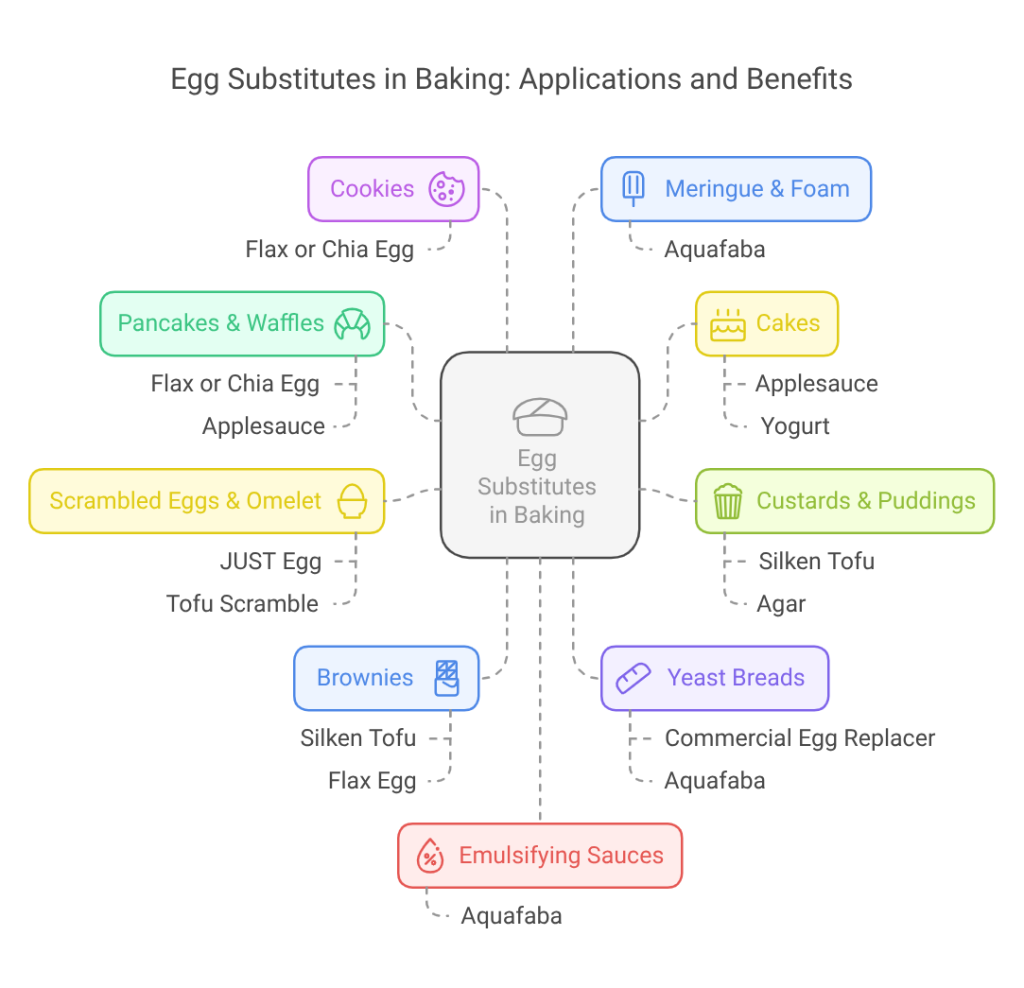
Note: For any given recipe, you might sometimes combine substitutes. For example, some vegan cake recipes use flaxseed + aquafaba together – flax to bind, aquafaba (whipped) to leaven. Or banana plus a little baking soda (banana for moisture, and its acidity with soda for lift). Don’t be afraid to use a two-pronged approach if one substitute alone isn’t doing everything an egg would.
This table is a starting point – of course, individual recipes may respond differently, but these guidelines are a safe bet. Now, let’s go over some general pro tips to ensure success when cooking or baking without eggs.
Pro Tips for Cooking & Baking Without Eggs
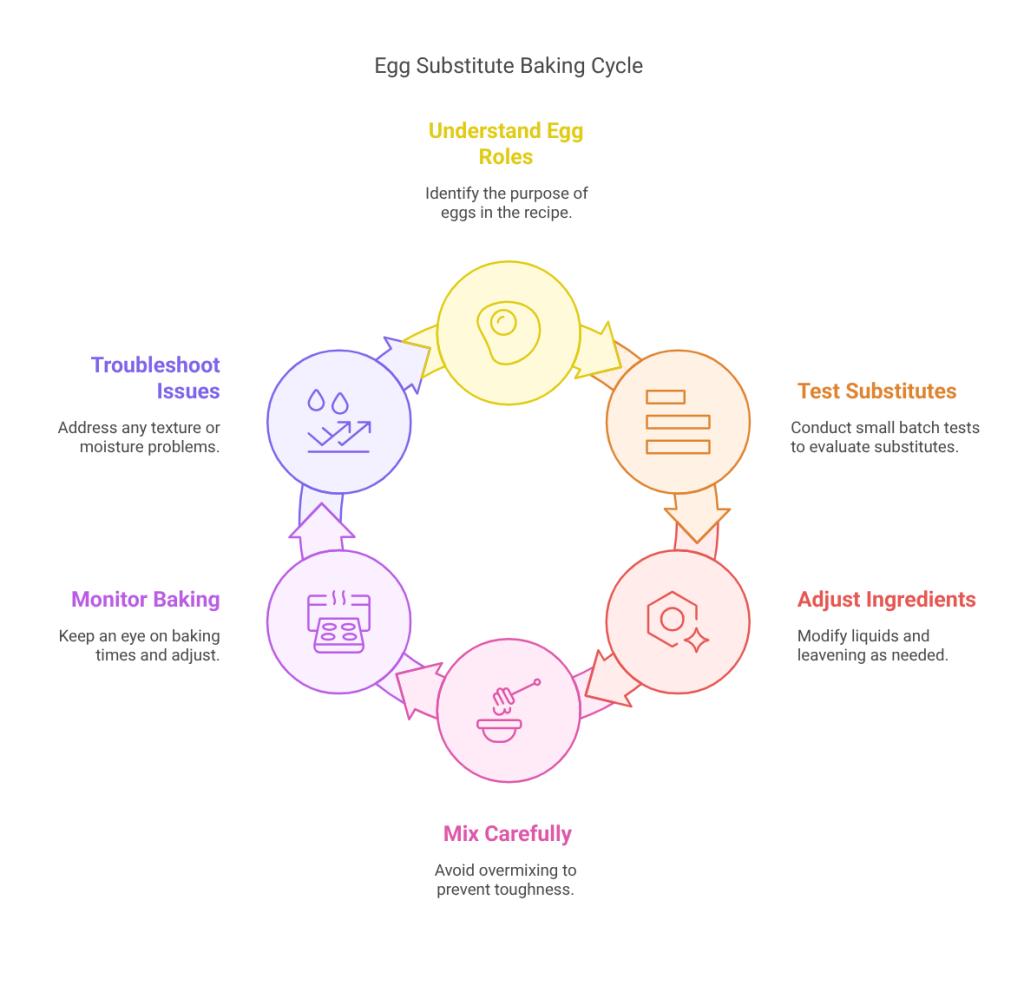
Even with the perfect substitute, egg-free cooking can have its quirks. Here are some tips from the experts (and grandmotherly kitchen wisdom) to help you achieve the best results when using egg alternatives:
- Understand the Egg’s Role in Your Recipe: Before substituting, identify whether eggs are there for leavening, binding, moisture, or all three. For instance, a sponge cake relies on eggs for airiness, while a biscotti uses egg mainly to bind the dough. Match your substitute to that function (use aquafaba for foam/leavening, flax for binding, etc.). Sometimes you may use two different substitutes to cover all roles in a complex recipe – and that’s perfectly okay.
- Test in a Small Batch: If you’re adapting a beloved recipe to be egg-free, consider making a half-batch or a small test first. This is especially useful for baked goods. See how the substitute performs – did the cookies spread too much? Did the cake rise and set properly? A trial run saves you from potential disappointment and lets you adjust before the big batch.
- Don’t Overmix Egg-Free Batters: Without eggs, some batters can be more sensitive to overmixing (which develops gluten and can make things tough). Once you’ve added your substitute, mix just until combined, unless the recipe specifically needs long mixing. For example, when using flax egg in a cake, stir gently; the flax provides structure, but overworking the flour could make up for the lost structure in a bad way (i.e., toughness).
- Adjust Liquids if Needed: Egg substitutes can alter the moisture content of a recipe. Applesauce or yogurt adds more liquid than an egg might; flax or chia might absorb liquid. If your batter looks too thin or too thick compared to when made with eggs, don’t be afraid to adjust. You can add a touch more flour if it’s too loose (or the reverse, a spoonful of milk or water if it’s too stiff). Experience and visual cues help here – with time you’ll get a feel for the right consistency.
- Boost Leavening for Fluffier Results: Eggless recipes sometimes turn out denser. A good trick is to increase the leavening slightly. For example, if using fruit puree (applesauce, banana) or a heavy substitute like tofu, add an extra 1/4 to 1/2 teaspoon of baking powder per egg replaced (Best Egg Substitutes For Baking). This compensates for the lift that the eggs might have given. Similarly, a pinch of baking soda (1/4 tsp) can be added if the recipe has an acidic component, or use the vinegar + baking soda trick for more rise.
- Embrace Emulsifiers: If your substitute egg batter is curdling or not coming together smoothly (say, oil separating in a batter), consider adding 1/2 teaspoon of soy lecithin (if available) or a bit of mustard (in savory recipes) to act as an emulsifier. Egg yolks emulsify naturally; without them, sometimes mixtures separate. For mayonnaise, aquafaba usually emulsifies well on its own, but using a small amount of lecithin or prepared egg replacer powder can stabilize it further.
- Use Room Temperature Ingredients: This is a general baking tip, but especially with egg substitutes it helps. Flax and chia gels thicken better at room temp. Cold ingredients can cause substitutes like aquafaba or commercial replacers to not integrate as well. If you’re using yogurt or silken tofu as an egg sub, having them at room temperature ensures they blend into the batter smoothly without lumping or shocking the batter (which can affect rise) (Discover the Best Egg Substitutes for Baking).
- Let Batters Rest (Sometimes): This may seem contradictory to “bake immediately with vinegar/soda”, but it depends. For substitutes like flax/chia eggs, a short rest of the mixed batter (10-15 minutes) can actually improve texture, as those seeds continue to hydrate and bind. Pancake batter, for example, benefits from a rest when made egg-free – it results in more tender pancakes. However, if you’ve used the vinegar+baking soda method or whipped aquafaba, you’ll want to get it cooking right away to capture the leavening. So judge based on your substitute: hydrating substitutes (flax, chia, some commercial powders with gums) = a brief rest can help; rapid gas substitutes (soda+acid, whipped foam) = bake immediately.
- Watch Baking Times: Egg-free baked goods can sometimes bake faster or slower depending on the substitute. For example, items with fruit puree might take a bit longer to cook through (they’re wetter), while cookies with a powder replacer might firm up quicker. Use visual cues and toothpick tests to check doneness rather than strictly the old timing. It might take a few extra minutes for that eggless banana bread to set in the middle, or your cookies might be done 2 minutes sooner without eggs – keep an eye out.
- Troubleshooting Texture Issues: If your first attempt comes out too dry or crumbly, that indicates not enough binding or too little moisture. Next time, try adding an extra tablespoon of liquid (milk or water) or use a combo of substitutes (e.g., flax egg + a tablespoon of applesauce) to amp up moisture. If something comes out too wet or gummy, it could be undercooked or you used too heavy a hand with moisture-rich substitutes. Bake a tad longer, or reduce other liquids slightly next time. If a cake didn’t rise much and is heavy, consider incorporating a fluffing method (whip aquafaba or use vinegar+soda) along with your binder next round.
- Pair Substitutes for Success: Don’t feel limited to one substitute – sometimes the best result comes from using two. Example: For a light cake, you might use a flax egg for binding plus whip 3 tablespoons of aquafaba to soft peaks and fold it in for leavening. Or use applesauce for moisture and Ener-G powder for binding together. This tag-team approach can closely mimic the multifaceted role of a real egg. Another combo bakers use is flax egg + a bit of carbonated water in batters – flax for structure, carbonation for lift (carbonated water can add airiness). The key is balancing the various needs of the recipe.
- Enhance Flavor When Needed: Some substitutes (like tofu or certain commercial replacers) are very neutral and can slightly mute the flavor of a recipe (since eggs have some flavor and salt of their own). To counteract this, you might want to bump up flavorings a bit. Add an extra splash of vanilla in cakes, a pinch more spice in muffins, or a tiny extra bit of salt to mimic the seasoning that eggs naturally provide. Nutritional yeast or black salt (kala namak) can give an “eggy” flavor to scrambles and quiches if desired – a little pinch goes a long way for aroma.
- Practice and Patience: Cooking without eggs is a skill like any other. The first time, your eggless custard might be a bit soft or your cookies a bit different – but you’ll learn and improve. Soon you’ll know exactly how your go-to egg substitute behaves in your oven or on your stove. Keep notes of what works well for you.
Remember, each recipe can be unique. Don’t be discouraged by an iteration that isn’t perfect – use these tips to tweak and try again. Egg-free cooking often requires a bit of experimentation, but once you dial in the right approach, you’ll achieve results that are just as delightful as the original.
Summary
Cooking and baking without eggs may seem challenging at first, but as we’ve seen, there’s a world of clever substitutes available – from flaxseeds and aquafaba in your pantry to innovative commercial products on store shelves. By understanding why eggs are used in a recipe, you can choose the substitute that best fills that role and even discover that some substitutes bring their own bonus benefits (for instance, flax and chia add healthy Omega-3s, bananas add natural sweetness, etc.).
Don’t be afraid to experiment. Perhaps start with a simple swap in a recipe you know well (like using a flax egg in your favorite muffin recipe) and see how it goes. Over time, you’ll build confidence in mixing and matching substitutes to get the texture and flavor you want. You might even create new recipes that shine on their own – not just as “egg-free” but as delicious dishes in their own right. Some bakers find that using applesauce or banana can make a cake more moist and flavorful than the egg version, or that aquafaba creates an exceptionally light meringue that impresses everyone.
In an era of frequent egg shortages and ever more dietary preferences around the table, having these egg alternatives in your culinary toolkit is invaluable. Whether you’ve gone vegan, developed an allergy, or just ran out of eggs on a Saturday morning, you can still flip pancakes, bake cookies, or whip up mayo with confidence.
As you try these substitutes, you’ll likely discover new favorites. Maybe you’ll love the richness that silken tofu gives your brownies, or the ease of pouring JUST Egg for a quick scramble. Embrace the creativity – cooking is as much science as art, and you’re now equipped with the scientific know-how to replace eggs, so you can focus on the art of making your food taste wonderful.
Happy egg-free cooking! With this ultimate guide at hand, you’re ready to tackle everything from fluffy vegan cakes to golden eggless mayonnaise. Remember, each time you swap out an egg for a plant-based alternative, you’re not just making do – you’re often making something new and potentially even better. So crack on (no eggshells required) and enjoy your egg-free culinary adventures.
And if you need inspiration, be sure to check out our egg-free recipes and product reviews elsewhere on our site. You’ll find tested recipes for classics like egg-free brownies, aquafaba meringue cookies, vegan quiches, and more – all to reinforce that going eggless is absolutely doable and delicious.
Bon appétit!


